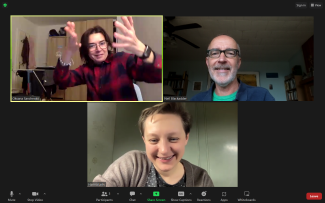
Translation of “My Hell,” a sharp, thought-provoking tragicomedy by well-established Ukrainian playwright Oksana Savchenko, became my focus during my translation residency at Princeton University in the spring semester. Theater translation had been on my mind since I co-organized the panel “Translating, Publishing, and Producing Ukrainian Drama” in the fall, where theater aficionados Sam Buggeln, John Freedman, and Anna Halas join me in a Zoom conversation. While my previous translation work had primarily been in fiction and creative non-fiction, the panel piqued my interest in drama translation.
During the spring semester, I was set to co-teach translation workshops as part of Prof. Karen Emmerich’s class “Translation, Migration, Culture.” As I contemplated which text to choose to workshop with students, my thoughts circled back to theater. Around the same time, I learned about the translation program’s strong relationship with the program in theater and that organizing a staged reading on campus was certainly a possibility.
The next thing I knew, I was texting my friends who were intimately familiar with the Ukrainian theater scene. My query was straightforward: I was scouting for a contemporary play written after the beginning of Russia’s full-scale invasion, dealing with the experience of displacement or being a refugee. I searched for a relatively short play with a small cast that would address the ongoing war while also having universal appeal and making a good fit for a student production on campus. Six manuscripts landed in my inbox. All of them were great in their own ways, but one stood out to me as probably the best fit for my requirements. I reached out to Oksana, got the greenlight to translate her play, and got down to work.
“My Hell” portrays the experiences of Ukrainian refugees, set designer Olena and her teenage daughter Marysia, who come to Germany in spring 2022 and move in with a German host family: art teacher and devoted vegan Helena and her 25-year-old son Luka, who works as a volunteer for the suicide prevention line. There’s also Paul, Helena and Luka’s vigilant neighbor who gives all of them a lot of grief. The play explores issues of culture shock, refugee stereotypes, mental health, and experience gaps, and has a fair share of dark humour and sarcasm—hence its genre, tragicomedy.
One fascinating challenge I grappled with when translating “My Hell” was the interplay of languages. The original text is entirely in Ukrainian, which stands for German within the context of the play. The playwright notes that Helena and Luka speak German, while Olena and Marysia speak German with their German host family and Ukrainian with each other. What’s more, the Ukrainians speak German with an accent, and if Marysia is quite fluent, then Olena is a bit less so and makes a few minor grammatical mistakes.
How did I handle that? In my translation, everyone speaks English. I chose not to give accents to Olena and Marysia to avoid transplanting them to a specific American region or, what’s even worse, creating a potentially comical effect. They don’t make grammatical errors, either. Instead, I played with their voices: with different tones, registers, and the use of specific phrases and idioms that might reveal them as non-native speakers. For example, when Marysia learns that Luka works for a crisis line, she asks, “How do people here usually finish themselves?”—which is not exactly the way native speakers would typically phrase it. Luka then seeks clarification: “Finish themselves?” And Marysia comes up with a more ‘correct’ idiom: “I mean… take their own life.”
To highlight the linguistic difference between Helena and Luka, who speak German fluently, and Olena and Marysia, for whom German is a second language, I had both Germans speak perfectly fluent English (with Helena slightly more formal and Luka more conversational) and both Ukrainians speak more or less neutral English (again, Marysia leaning towards casual, slangy expressions—she’s a teenager, after all!). Sometimes, I showed them searching for particular words (Olena: “My great-grandfather bought it at this market where they sell old things…umm... at the flea market). However, in scenes where Olena and Marysia are alone and speak Ukrainian between themselves, their English (which now stands for Ukrainian; I know it’s complicated…) becomes completely fluent.
Another strategy I used to preserve the play’s linguistic landscape and remind the audience about its setting was sprinkling in German and Ukrainian words into the characters’ dialogue. The keyword here was “sprinkling,” not tossing a handful. I did this in four kinds of situations.
- One, during emotionally charged moments, like when characters are caught off guard: “Marysia turns around and bumps into Luka. She almost jumps. “O Bozhe!” she exclaims.” In the real-life setting, I can only imagine Marysia crying out ‘Oh God’ in her native language, Ukrainian—so that’s what I had her say in my translation. Or they address someone else with love: “Olena: ‘Where are you, sontse?’” meaning ‘sweetie.’
- Two, when characters curse: “A green parakeet flies above Paul and shits on his head. Paul shouts: “Green scheisse!” or, talking about Russians looting her friend’s home: “Marysia: One katsap stole my friend’s toilet but, curiously enough, didn’t touch her keyboard. Hondon!” (meaning ‘scumbag’).
- Three, when there are culturally specific concepts, as in: “Luka: It’s just that in Germany we have Ruhezeit. You’re not supposed to make noise from ten pm to eight am.”
- And four, in dialogues between Olena and Marysia, where I used Ukrainian words to signal a switch from German to Ukrainian.
As I translated this play, I was fortunate to get almost instant feedback from my students—I workshopped a few scenes with them in class—colleagues, student actors who volunteered to participate in the staged reading of “My Hell,” and theater translator and director Neil Blackadder, who directed the reading. Their comments were invaluable and helped me improve and fine-tune my translation so that all five characters spoke with distinct, authentic voices and humor came through, eliciting laughter from the audience in all the right places. Participating in the rehearsals, collaborating with actors and the director, and witnessing the backstage process of taking a translated script to the stage was just as incredible.
The other day, Neil and I had a Zoom call with Oksana, who’s now based in Heidelberg, the very town where the play is set. Her story about how the play came together, how all the characters had their prototypes (and that pesky neighbor, Paul, was her actual neighbor pounding on her wall one minute after 10 pm!), and how she herself imagined each of them, was very helpful for me as I tried to transplant her work into English.
I was also extremely grateful to my translator friend Larissa Kyzer, who texted me in late March and suggested, “Why don’t you read from your translated play during this Sant Jordi festival in New York, which celebrates literature and theater and translation?” I thought, “Umm… sure, why not?” So, a month later, four scenes from “My Hell” premiered at Sant Jordi, offering a taste of contemporary Ukrainian drama to the American audience both at the theater and online (the reading was streamed live).
Finally, on May 1, a full-fledged staged reading took place at the Lewis Center for the Arts in Princeton, marking the culmination of a series of Ukraine-related events I organized on campus over the past academic year—and serving as a finale to a fascinating process of translating one skillfully crafted Ukrainian drama into English, with the generous support of so many and an important goal: amidst the genocidal war, to make Ukrainian culture a bit more visible abroad. One play at a time.
Interviewed by Hanna Leliv