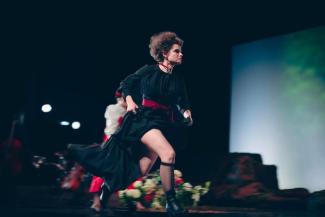
A powerful gesture of cultural exchange recently unfolded through a French-language adaptation of The Forest Song by Lesia Ukrainka, a cornerstone of Ukrainian literature. Staged at Théâtre du Préau, Le Centre Dramatique National de Normandie-Vire, this collaboration transcended the boundaries of traditional theatre. Directed by Lucie Berelowitsch and infused with the creative energy of the Dakh Daughters, the production became a vivid conversation between past and present, East and West, text and sound.
More than a staging of a poetic drama, this production was a living act of artistic diplomacy. With over 70 performers—including professional actors, students from the Conservatoire de Vire, members of the Chorale de Saint-Sever, and pupils of Lycée Marie Curie—it stood as a communal creation. Voices from different countries, backgrounds, and generations merged into one choral reflection on the human condition. The adaptation honored Ukrainka’s themes while expanding them into new emotional and political dimensions.
The Dakh Daughters—known for blending cabaret, ritual, and resistance—did more than compose the score. They infused the performance with elements of Ukrainian folklore, visual poetry, and urgent emotion. Their presence on stage, in both word and gesture, gave Mavka’s world a new rhythm. Alongside them, French actors Léopoldine Hummel, Guillaume Bachelé, and Thibault Dallaire offered nuanced portrayals, building a bridge of empathy and artistry.
This staging of The Forest Song opened a rare portal for cultural exchange: where language shifted, but spirit remained intact. Ukrainian songs and dances learned by local youth added authenticity and intimacy to the production. What emerged was not just a play, but a collective ritual of resistance, memory, and hope. In a time marked by displacement and war, Ukrainian art found a new voice—speaking clearly, and movingly, in French.